No products in the cart.

Feeling boxed in by your small office? You're not alone. Let’s reframe this challenge. It’s not about needing more space; it's about using the space you have smarter. The very best small office organization ideas aren't about buying a hundred new bins—they're about intentional decluttering, getting creative with vertical storage, and building a workspace that actually inspires you.
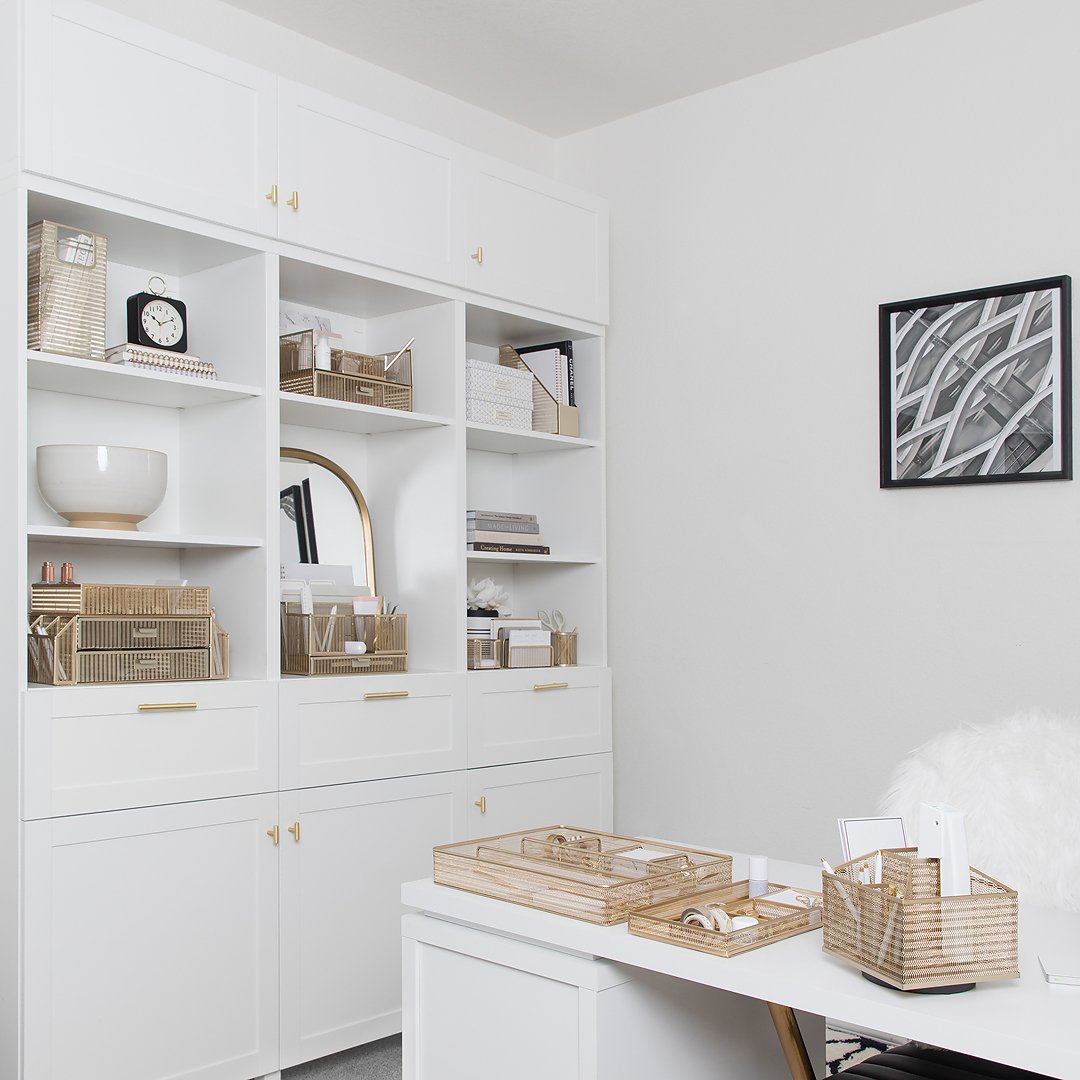
An overflowing desk isn't just physical clutter. It’s mental noise. That constant, low-grade hunt for a pen, a specific file, or the right charging cable creates tiny moments of friction that add up to major frustration by the end of the day. Whether you're a remote professional, a teacher grading papers, a student deep in study mode, or an entrepreneur building a dream, we've all felt that sense of our workspace working against us.
This guide isn't about generic tips you've heard a thousand times. We're diving into real-world strategies to help you build a small but mighty hub of productivity that feels uniquely yours.
A truly organized office is so much more than a clean desk. It’s an environment intentionally designed to support your best work, quiet the distractions, and give you a feeling of calm control. It's not just a hunch; a recent study actually found that a disorganized workspace can increase cortisol levels, the body’s primary stress hormone. When you implement smart organizational systems, you're not just tidying up—you're literally designing a less stressful, more productive day for yourself.
"An organized space is an organized mind. When you clear the clutter from your desk, you make room for clarity and creativity to flow."
This guide will walk you through actionable ideas to help you:
Establish a foundation by thoughtfully decluttering your desk and immediate surroundings.
Maximize your footprint by finally taking advantage of the vertical space you've been ignoring.
Create visual harmony with coordinated accessories that make your space feel intentional and polished.
Design a workflow-friendly layout that puts comfort and efficiency first.
Build lasting habits to effortlessly maintain your newly organized and inspiring office.
It's time to stop fighting with your cramped workspace. Let's transform that small corner from a source of chaos into your personal sanctuary of calm productivity. Let's get started.
Real organization starts with subtracting, not just shuffling things around. Before you even dream of buying that perfect set of file sorters or desk trays, the most powerful thing you can do is create a blank canvas. This isn't about a ruthless purge that leaves you feeling stressed; it's about making deliberate, thoughtful choices about what truly deserves to occupy your valuable workspace.
Every single item in your office, from a lone paperclip to your trusty laptop, needs a reason to be there and a place to live. I call this the "Everything Has a Home" philosophy, and it's the absolute bedrock of a workspace that stays organized for good. When an item has a clear spot, putting it away becomes second nature, stopping that slow, creeping clutter in its tracks.
First things first: take everything off your desk. And yes, I mean everything. This forces you to physically touch each object and ask yourself some simple but crucial questions. As you handle each item, sort it into one of three piles:
Daily Essentials: These are your non-negotiables, the tools you reach for multiple times a day. We're talking about your monitor, keyboard, mouse, and your favorite notebook. These items earn the prime real estate on your desk, right within arm's reach.
Frequent-Use Items: This pile is for things you need regularly, but not constantly. Think of your stapler, that specific pen you love for editing, or reference books. These should live close by—maybe in the top desk drawer or a wall organizer—but not cluttering your main work surface.
Occasional or "Just-in-Case" Items: This is where you get honest with yourself. This pile is for old project notes, duplicate supplies, or manuals you could easily find online. Ask the tough question: can this be scanned, stored away, or simply tossed?
Your goal is to curate your workspace like an artist curates a gallery, showcasing only the tools that help you do your best work. Every unnecessary item you remove is a win for your focus.
As you sort, you'll naturally spot opportunities to consolidate. For example, instead of three half-used notepads floating around, commit to using one high-quality journal. Ditch that messy pile of incoming papers for a single, sleek inbox tray—and make a promise to yourself to clear it out every day.
This thoughtful approach is more important now than ever. The explosion of small and home offices, part of a global market valued at a staggering USD 21.1 billion in 2023, shows just how many of us are working in more compact spaces where every square inch is precious.
With 33.3 million small businesses in the U.S. alone, many of them run from a spare room or a kitchen corner, decluttering isn't just a nice idea—it's a critical strategy for productivity. You can read more about the SOHO market and its impact on workspace design to see just how big this trend is. By clearing the physical and mental clutter first, you're not just tidying up; you're setting the stage for a truly functional and inspiring place to work.
When you're short on desk space, the only way to go is up. It’s a simple concept, but truly embracing the vertical space above and around your workstation can completely change the feel and function of your small office. This isn't just about sticking a shelf on the wall; it’s about creating a smart, multi-layered system that keeps your essential tools visible and right where you need them.
Say goodbye to a desk buried under mountains of paper and supplies. Instead, picture sleek floating shelves holding a few inspiring pieces of decor next to your most-used reference books. Or imagine a pegboard system where everything from your scissors to your charging cables has its own designated spot, ready to grab in an instant. Your walls are prime real estate—let's turn them into a command center.
The trick is to choose vertical storage that actually fits how you work. These aren't just practical solutions anymore; they’ve become a huge part of modern office design.
Wall-Mounted File Organizers: These are brilliant for keeping active project files, incoming mail, or important papers off your desk but still in your line of sight. You can explore a variety of wall mount organizers to find a look that matches your office aesthetic.
Stackable Letter Trays: An oldie but a goodie. A simple vertical inbox/outbox system on your desk or a nearby shelf can instantly tame the paper clutter.
Pegboard Systems: If you love flexibility, pegboards are your best friend. You can reconfigure them with shelves, hooks, and bins to hold everything from pens and notebooks to all your tech gadgets.
Of course, before you can build up, you have to clear out. This guide breaks down that crucial first step.
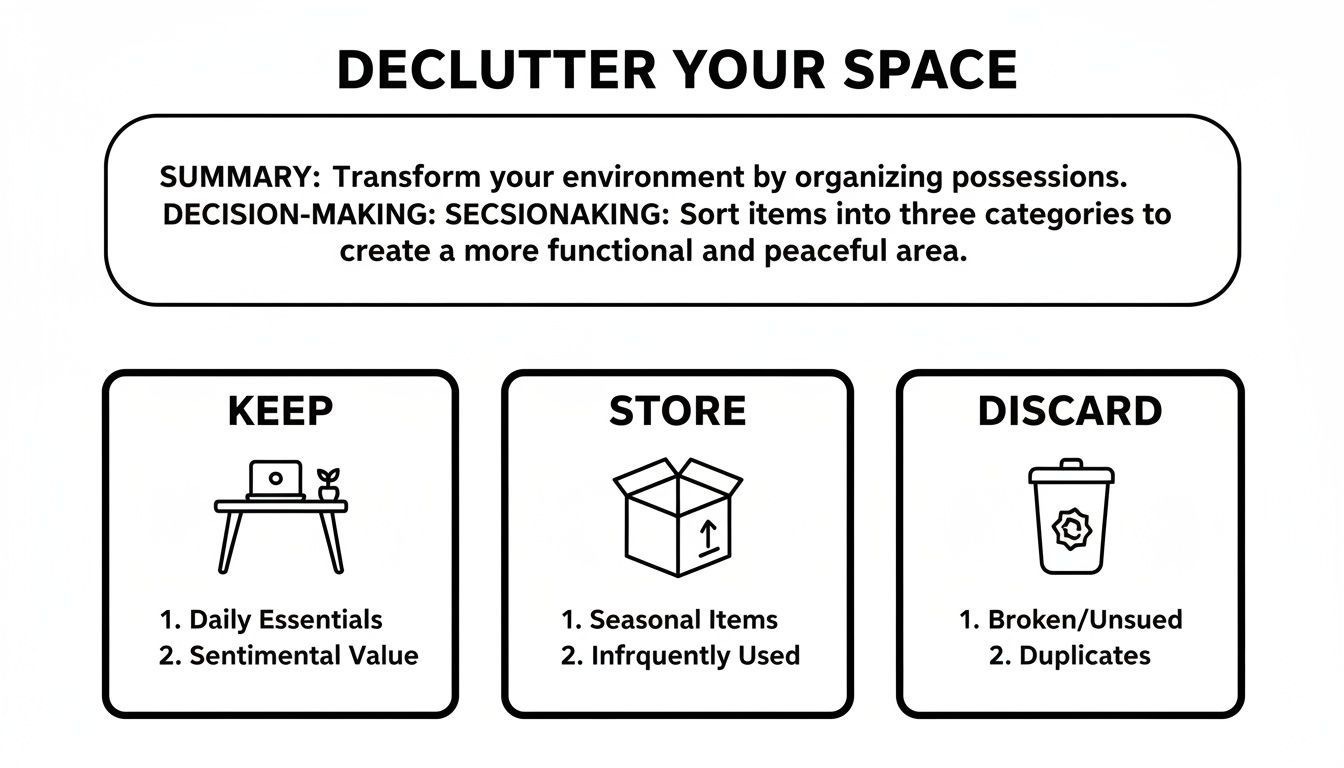
Once you know exactly what you need to keep close, what can be stored, and what needs to go, you can make much smarter choices about the kind of vertical storage that will work for you.
To help you visualize the possibilities, here’s a quick comparison of some popular vertical storage options. Finding the right fit can make all the difference in managing everything from loose papers to essential supplies in a tight workspace.
| Storage Type | Best For | Example Usage |
|---|---|---|
| Floating Shelves | Displaying books, decor, and less-frequently used supplies. | A shelf above your monitor for reference books, plants, and extra notebooks. |
| Wall Grids/Pegboards | Highly customizable storage for small tools and accessories. | Organizing scissors, tape, cables, and small bins for paper clips or pens. |
| Wall-Mounted File Holders | Active projects, mail, and important documents. | Sorting client files, "to-do" paperwork, and incoming invoices. |
| Tall, Narrow Bookshelves | Maximizing storage for books, binders, and storage boxes. | Placing it next to a desk to house binders, printers, and archival boxes. |
| Over-the-Door Organizers | Storing supplies you don't need daily but want accessible. | Pockets filled with extra printer paper, ink cartridges, and mailing supplies. |
Whether you go for a sleek, minimalist look with a single floating shelf or a full-on utility wall with a pegboard, the goal is the same: get things off your desk and onto the wall.
This move toward clever, good-looking organization is more than just a passing phase—it’s a massive market. The global office storage and organization industry was valued at around USD 4.1 billion in 2024 and is expected to more than double to USD 8.7 billion by 2034.
That incredible growth shows just how much people want modular, attractive solutions that are both functional and stylish. As you can discover in more detail from market analysis, we're all looking for products that help our small spaces work harder and smarter.
By thinking vertically, you’re not just storing things—you’re designing an efficient, three-dimensional workspace that supports your daily tasks and clears your mind for focused work.
For a designer, this could mean using wall-mounted pockets to keep fabric swatches organized and visible. For a remote worker, it might be a simple shelf above the monitor holding notebooks and a charging dock. The whole point is to elevate your most important items, clearing the way for productivity to happen.
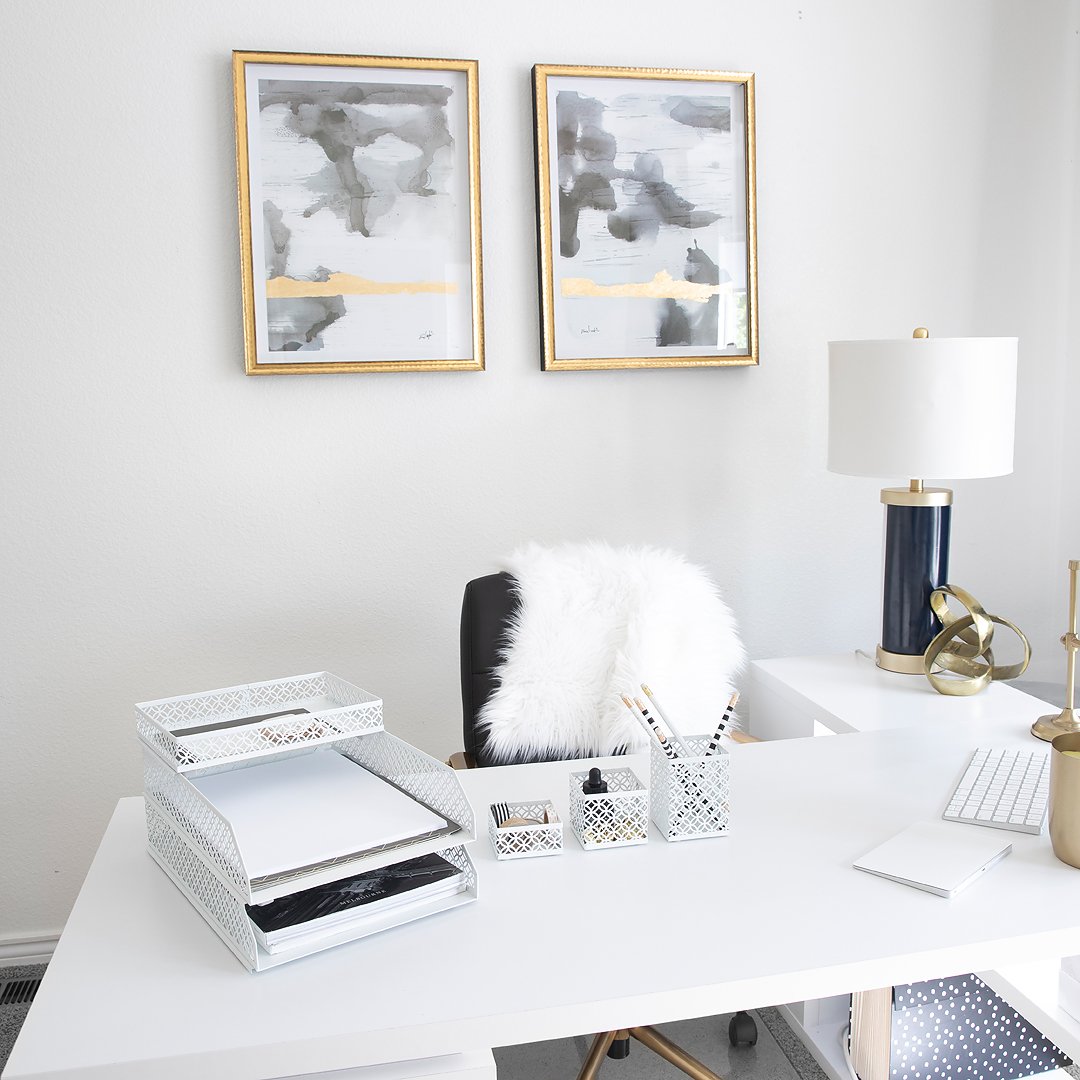
An organized office should feel as good as it looks. After you’ve done the hard work of decluttering and going vertical with your storage, this is the fun part—adding that final touch that creates a sense of visual peace.
This is where coordinated accessories come in, transforming a purely functional desk into a workspace that genuinely inspires you. A unified aesthetic makes even the smallest corner feel more intentional, polished, and surprisingly spacious.
Think of it this way: a random jumble of mismatched pen holders, plastic trays, and freebie sticky note pads creates a subtle, low-grade hum of chaos. Even when things are technically put away, that visual noise is still there. But when you swap those items out for a matching set, you instantly elevate the entire feel of your space.
It’s a simple change, but it sends a powerful signal to your brain: this is a curated, calm, and controlled environment. That visual quiet allows your mind to settle and focus on what really matters—your work.
Choosing a single theme for your accessories is one of the quickest ways to make a huge impact. This isn’t just about looking pretty; it’s about crafting a system that makes sense visually and functionally. When your file sorter, pen cup, and letter tray all speak the same design language, they look like they belong together. They create clear, beautiful zones for your tools.
Even your color choice can subtly influence your mood and productivity.
Warm Metallics: Finishes like gold or rose gold bring a touch of sophistication and warmth. They can make your desk feel more like a personal sanctuary and less like a sterile cubicle.
Cool Tones: Calming shades like teal, aqua, or soft blue are known to promote focus, making them perfect for deep, detail-oriented work.
Bold Monochromes: You can never go wrong with a classic black or white set. It creates a clean, minimalist vibe that cuts out distractions and feels timelessly professional.
The goal is to pick a style that doesn’t just hold your stuff, but actually energizes you. Your desk is a reflection of your professional self—make it a place that inspires you every single time you sit down.
Achieving this kind of harmony is much easier than it sounds, and you don’t have to do it all at once. Start with the things you see and use most often. A fantastic starting point is looking at coordinated desk organizer sets that bundle the core pieces together.
Picture it: a sleek metal file sorter holding your active projects, a matching pen cup with your favorite pens, and a letter tray that elegantly contains incoming papers. Every piece works in concert, creating a visual flow that makes your desk feel less like a random collection of things and more like a cohesive command center.
This principle is especially powerful in a small space. By unifying the look of your accessories, you encourage the eye to glide across a smooth, uncluttered landscape. The result is a workspace that feels bigger, brighter, and ready for anything. It’s this final layer of polish that takes a desk from just being “tidy” to being a truly productive and joyful place to be.
True organization is really all about function and flow. A beautiful desk is great, but if it doesn’t actually support the way you work, the clutter will always find its way back. Let’s think about designing your desk layout less like an interior designer and more like an efficiency expert, creating a space where every movement feels completely natural and intuitive.
Imagine your desk is a small landscape with distinct neighborhoods, or what I like to call "work zones." This simple idea is a game-changer for bringing order to chaos. By giving specific areas a dedicated purpose, you’re essentially creating a physical map for your workflow, which helps keep everything exactly where it belongs.
Most of us can break down our daily grind into three main types of activities. When you arrange your tools to match these categories, you’ll be amazed at how much friction disappears from your day.
The Digital Zone: This is your command center, front and center. It’s where your monitor, keyboard, and mouse live. To save your neck and back, position your monitor directly in front of you—about an arm's length away—with the top of the screen at or just below eye level.
The Analog Zone: This spot is for all your non-digital tasks, like jotting down notes, sketching ideas, or signing documents. It should live on your dominant side. If you're right-handed, your notebook, journal, and favorite pens go on the right. This small shift stops you from constantly reaching across your body and disrupting your focus.
The Reference Zone: This area is for items you need to glance at but aren't actively using all day. Think reference books, your phone stand, or a small stack of current project files. This zone usually works best on your non-dominant side or tucked just behind your main digital setup.
This zoning strategy isn't just a nice idea; it's becoming essential. The global flexible office market, valued at a massive USD 39.57 billion in 2024, is built on the idea of compact, efficient desks. As more companies adopt hot-desking, knowing how to organize your essentials in a small footprint is a critical skill. You can discover more insights about the flexible office market to see just how much this trend is shaping our work habits.
Nothing kills a beautifully organized vibe faster than a tangled nest of cords. Getting that mess under control is one of the most satisfying quick wins in office organization.
Start by bundling loose cables together with simple velcro ties. Next, run them along the back edge or underside of your desk using adhesive clips to get them completely out of sight.
A clutter-free desk surface is a direct path to a clutter-free mind. Taming your cables is one of the fastest ways to reclaim that sense of calm and control.
For the grand finale, tuck a power strip inside a cable management box on the floor or, even better, mount it directly to the underside of your desk. This simple move hides all those bulky adapters and keeps the floor clear. Even the smallest bits of clutter, like stray charging cables or loose paperclips, deserve a home. A simple but elegant gold metal desk drawer organizer tray can turn a messy drawer into a model of efficiency, ensuring every inch of your space serves a purpose.
You did it. You’ve carved out a calm, productive workspace where everything has a home. But here’s the secret no one tells you: the real win isn't the big initial overhaul; it's making that new sense of order stick around for the long haul.
A clutter-free desk isn't a one-and-done project. It’s a series of small, consistent habits that stop the mess from ever creeping back in. The trick is to weave these little routines right into your workday, so staying organized becomes a natural part of how you operate, not another chore on your to-do list.
Think of these as your daily and weekly rituals. They’re tiny investments of time that deliver a huge return in focus and clarity.
The 5-Minute Wind-Down: Before you shut down for the day, give yourself just five minutes. Seriously, set a timer. Put pens back in their cup, drop loose papers into your "inbox" tray, and give your desk a quick wipe. This simple ritual closes out your workday and guarantees you’ll walk into a fresh start tomorrow morning.
The Weekly Reset: Block out 15-20 minutes on your calendar every Friday afternoon. This is for a slightly deeper reset. Go through that inbox tray, file away documents for completed projects, and sort any new supplies that have landed on your desk. It’s like hitting a reset button for your brain, letting you unplug for the weekend and come back to a truly clean slate on Monday.
Your organized office is a living, breathing space, not a museum exhibit. It needs a little bit of regular attention to stay at its best. Think of it like a garden—a little tending each week keeps it from getting overgrown.
Your organizational system is there to support you, not to box you in. As your work changes, so will your needs. The setup that was perfect for a massive research project might need a few tweaks when you switch to a more collaborative, fast-paced task. Don't be afraid to adjust.
A fantastic rule to live by is the "one in, one out" principle. Bringing in a new notebook? An old, half-used one has to go. Bought a new set of fancy pens? The dried-out ones get tossed. This simple habit single-handedly prevents the slow, silent pile-up of "stuff" that inevitably leads to overflowing drawers.
By making these small actions part of your routine, you’re not just cleaning your desk—you’re committing to a workspace that consistently inspires you to do your best work.
Even with a solid plan, a few nagging issues can pop up when you're organizing a small workspace. Don't worry, it's completely normal. Let's walk through some of the most common organizational puzzles and find solutions that actually work.
Ah, the dreaded drawerless desk. It’s sleek and modern, but where does everything go? The secret is to think up, not out.
Start with desktop file sorters to keep your active papers from piling up. I'm also a big fan of stackable trays for things you grab constantly, like sticky notes, pens, and highlighters. This simple trick keeps your main work surface from becoming a chaotic landing pad.
For everything else you need but don't use every single minute, a rolling cart is your best friend. Tuck it right beside your desk, and you've essentially created a mobile drawer unit. You can also turn your wall into a storage powerhouse with a versatile pegboard system or some simple wall-mounted organizers. Getting supplies off your desk entirely is a total game-changer.
That tangled mess of wires can completely ruin the vibe of an otherwise tidy desk. Let's tame the cable monster for good.
First, group related cords together. You can use simple velcro ties or a fabric cord sleeve to create one neat bundle. Then, run that bundle along the back or underside of your desk using adhesive cable clips. Out of sight, out of mind.
If you want a truly clean, professional look, the cable management box is your hero. This simple container hides the entire power strip and all the messy, excess cord length. It’s a small investment that makes a massive visual impact.
This is such a common feeling, and it almost always comes down to one thing: your stuff doesn't have a designated "home." It's a sign that it might be time to do another quick decluttering sweep. Be honest with yourself about what truly needs to be within arm's reach.
Try this simple technique called containment. Use small, stylish trays to group similar items—one for your pens, one for paper clips, another for charging cables. This prevents small things from scattering and creating that constant sense of visual noise. It imposes a natural order and makes the end-of-day tidy-up take about two seconds.
Ready to build a workspace that truly inspires you? Find your perfect style with Blu Monaco’s curated collections of desk accessories and organizers. Explore our beautiful desk sets and wall organizers to start creating your dream office today.


