No products in the cart.

Think of this guide as your personal blueprint for turning any room into a place where you can do your best work. It’s more than just picking out a desk; it's a creative process of designing a space that flows with your day, keeps you focused, and feels genuinely you. We're going to build a workspace that is as functional as it is inspiring.
Welcome! Whether you’re tucking a desk into a quiet corner or outfitting an entire room, you’ve come to the right place. Together, we’ll walk through how to create a personalized environment that not only inspires incredible work but also supports your well-being. This is about building from the ground up—starting with a clear vision and ending with a space that just works.

Before we dive into the nitty-gritty of measurements and furniture, let's look at the big picture. These core principles are the foundation of every great workspace, guiding your decisions from the very beginning to the final touches.
| Principle | What It Means For You |
|---|---|
| Function First | Your workspace must support your actual tasks. Aesthetics are important, but they should enhance, not hinder, your productivity. |
| Ergonomics & Well-being | A comfortable setup prevents fatigue and strain. Your health is your greatest asset, and your office should protect it. |
| Workflow & Flow | The layout should make sense for how you move and work. Everything you need should be within easy reach to keep you in the zone. |
| Smart Storage | A place for everything, and everything in its place. Effective storage reduces clutter, which in turn reduces mental friction. |
| Personalization & Style | This is your space. It should reflect your personality and make you feel motivated and happy to be there. |
These ideas will be our North Star as we move through the planning process, ensuring the final result is a space you truly love.
Look at that empty room not as a problem to be solved, but as a blank canvas brimming with potential. Our goal is to transform a simple floor plan into a beautiful, high-functioning office that perfectly matches your professional needs and personal style.
This journey happens in a few key stages:
Assessing Your Unique Needs: First, we need to understand how you work. Do you crave quiet for deep thinking, or do you need a dynamic setup for video calls and collaboration?
Measuring and Mapping: Getting the dimensions right is non-negotiable. This is the difference between a desk that slots in perfectly and one that makes the whole room feel cramped.
Creating a Flowing Layout: We'll arrange furniture and define different zones to mirror your daily rhythm, smoothing out the friction points and boosting your efficiency.
This is where the magic starts. It’s in this planning phase that you’ll see how stylish organization, like the beautiful, coordinated collections from Blu Monaco, can elevate a space from just functional to something truly special.
The way we work is changing, and our spaces have to keep up. Even if you're designing a simple home office, you can pull inspiration from bigger trends. As more companies shift to hybrid models, they're getting smarter about using their space for maximum flexibility and impact.
A global analysis of office portfolios revealed a huge shift toward adaptable, data-driven layouts. In one stunning example, a publisher named Karger successfully cut its physical office footprint by a massive 80% by analyzing how its teams actually used the space. They proved that smart planning can foster collaboration without a single square foot going to waste.
For those of us working from home, the lesson is clear: prioritize multi-functional furniture and flexible setups that can evolve as our needs change. You can explore more of these fascinating global workplace insights on CBRE.com. This mindset helps ensure your office isn't just a room, but a dynamic environment that fuels your ambition.
Let's get started.
Before you even think about moving a desk or buying that perfect organizer, you have to lay the groundwork. Think of it like a chef prepping their ingredients before they start cooking. This is the part of the process that grounds your entire plan in reality, making sure every choice you make from here on out is smart, intentional, and works for you.
This is where you really get to know your room—its quirks, its potential, and its limitations. You'll become a bit of a detective, uncovering every detail from the exact dimensions to the placement of windows, outlets, and any odd architectural features. Doing this now prevents those all-too-common headaches later, like discovering the desk you just bought is an inch too wide or realizing your main power outlet is on the wrong wall.
Good measurements are everything. Seriously. Grab a tape measure, a notepad (or a notes app on your phone), and start by sketching a rough, top-down view of your room. It doesn’t have to be a masterpiece; a simple box or L-shape is perfect.
Now, it’s time to fill in the details. Methodically measure and write down the following:
Wall Lengths: Measure each wall from one corner to the other.
Ceiling Height: Knowing your vertical space is crucial, especially if you’re considering tall bookshelves or stacking storage.
Doors and Windows: Note their width and height, but also how far they are from the nearest corner. Don't forget to measure how much space a door needs to swing open!
Permanent Fixtures: Mark the location and size of anything that can't be moved—think radiators, built-in shelves, or structural columns.
Outlets and Switches: Pinpoint the location of every power outlet, data port, and light switch. This is absolutely vital for deciding where your desk and all your tech will live.
This little map becomes your single source of truth. It takes all the guesswork out of the equation and gives you the confidence to plan like a pro.
With the physical space mapped, it’s time to map out your professional needs. A stunning office that doesn’t actually support the way you work is just a pretty room. The goal here is to create a personalized 'needs inventory'—a checklist of everything your workspace must deliver to help you succeed.
A huge mistake people make is designing for an imaginary work life instead of their real one. Be brutally honest about your daily tasks and habits. That honesty is the secret to creating a space that genuinely makes you more productive, not just one that looks good in a photo.
To build your inventory, ask yourself some direct questions. Do you spend 80% of your day on video calls and need a clean, professional background? Or do you need a massive surface to spread out physical documents and blueprints? Answering these questions now ensures your final layout is as practical as it is beautiful. If you're working with a tight space, you might find our guide on small home office organization helpful for some extra tips.
Here’s a simple checklist to get you started:
Tech Requirements: Make a list of every single piece of equipment you use daily (e.g., laptop, two monitors, printer, scanner, ring light).
Storage Needs: How much physical stuff do you need to store? Think files, books, supplies, and product samples.
Work Style Analysis: Are you a "piler" who needs open trays for active projects, or a "filer" who prefers everything tucked away in drawers?
Meeting and Call Frequency: How often are you on calls? Is background noise an issue? Do you need a dedicated, quiet zone?
This inventory, when paired with your room measurements, creates the ultimate blueprint for your ideal workspace. You now have all the data you need to start defining zones and choosing furniture that fits both your room and your workflow perfectly.
A truly great office layout feels less like a static room and more like a well-choreographed dance, where every move is fluid and intuitive. After measuring your space and taking stock of your needs, it's time to translate all that data into a physical setup that actually supports your daily rhythm. This is where we stop thinking of an "office" as just a desk and chair and start designing a series of functional zones that make your workflow feel effortless.
Think of your office as a small, specialized city. Just as a city has a business district for commerce, parks for relaxation, and libraries for quiet study, your workspace needs distinct areas dedicated to specific types of tasks. This approach, known as zoning, transforms a simple room into a high-performance ecosystem.
Zoning is really the art of assigning a specific purpose to each corner of your office. By creating these little micro-environments, you're giving your brain a powerful cue. When you enter a designated zone, you’re mentally primed for the task at hand, which can dramatically cut down on mental friction and sharpen your focus.
Here are a few common zones you'll find in an effective office plan:
The Focus Zone: This is your command center, the spot for deep, concentrated work. You'll want to position it to minimize distractions—ideally facing a wall or a window with a calm view, away from the main doorway.
The Resource Zone: Think of this as your supply hub. It's the logical home for your printer, scanner, shredder, and essential supplies. Placing a hanging file organizer or a set of paper trays here keeps your main desk wonderfully uncluttered.
The Recharge Zone: Even the smallest office needs a space to decompress. This could be a comfy armchair in a corner with good light for reading or just an open patch of floor for a quick stretch. A dedicated spot to step away from the screen is absolutely crucial for staying productive all day long.
The process of measuring, mapping, and inventorying your space is the essential groundwork you need to do before you can define these zones effectively.
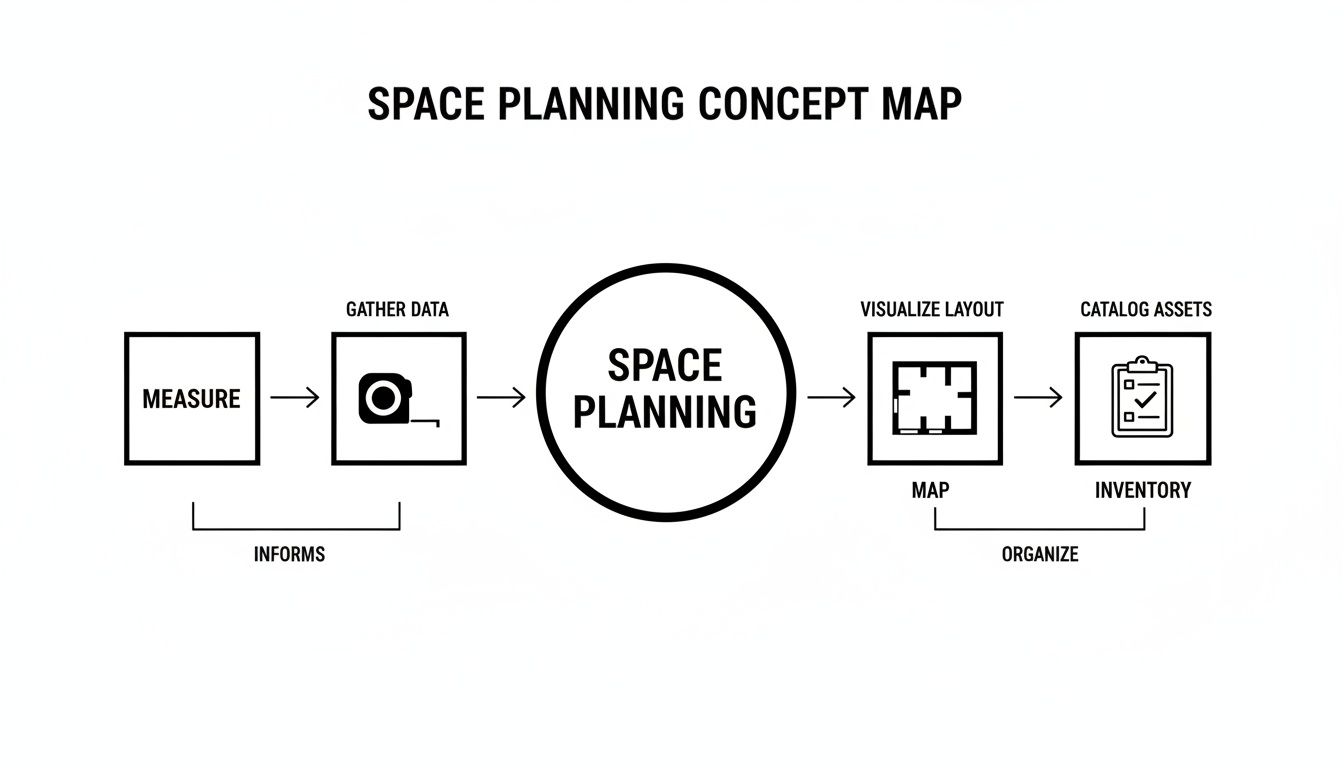
As you can see, a successful layout doesn't happen by accident. It’s built on a foundation of solid data about your physical space and the tools you use every day.
Once you've identified your key zones, the next step is to arrange them in a way that feels natural. The goal is to cut down on unnecessary movement and keep your most-used items within easy reach. Think about the path you trace during a typical workday. Are you constantly getting up to walk to the printer? Are your reference books stored clear across the room from your desk?
Arranging your space based on workflow is like organizing a kitchen. A chef keeps their knives, cutting boards, and favorite spices right next to the stove to work efficiently. Your office should follow the same simple principle of proximity and purpose.
For example, your Resource Zone should be close enough to your Focus Zone for convenience, but not so close that the whir of a printer becomes a distraction. Your daily planner and a sleek pen cup should live right on your desk, while bulk supplies like extra notebooks and ink cartridges can be tucked away in the Resource Zone. It's this kind of strategic placement that turns an abstract plan into a highly functional reality.
The old way of planning an office is giving way to more dynamic, data-driven approaches. Static layouts often fall short because they don't account for how we actually use a space throughout the day. Modern planning, even for a home office, is all about creating flexible zones that can adapt as your work changes.
This shift is happening on a massive scale. A recent study found that 89% of organizations now see space utilization metrics as their most valuable tool for creating effective work environments. In fact, 77% of businesses are actively investing in adaptable layouts and defined zones to better support how their teams really work. By applying these same principles to your own office, you’re creating a workspace truly built for modern productivity. You can dig deeper into how data is shaping office utilization strategies on Hubstar.com.
Now that you have your zones mapped out and a clear idea of your workflow, it's time for the fun part: bringing your office to life with furniture and storage. These pieces are so much more than just functional items; they are truly the backbone of your workspace. The right desk, chair, and organizers can completely change how you feel and work, turning a simple room into your personal engine for success.
Think of your furniture as the essential tools of your trade. A great desk is your surface for creation, a supportive chair is your foundation for hours of deep focus, and clever storage keeps everything else organized and right where you need it. This is the moment your thoughtful planning becomes a physical reality.
Your desk is the heart of your focus zone, so getting this choice right is absolutely critical. The perfect desk needs to fit the scale of your room while also supporting the actual work you do every day. Let's look at a few popular options.
Standing Desks: These are incredible for your health and energy levels. Being able to switch between sitting and standing is a game-changer. In fact, studies show that using one can burn extra calories and might even give your productivity a little boost.
L-Shaped Desks: If you're someone who needs to spread out, an L-shaped desk is your best friend. It offers a massive surface that’s perfect for multiple monitors, piles of paperwork, and other gear, and it tucks neatly into a corner.
Minimalist Desks: Working mostly on a laptop in a smaller room? A simple, streamlined desk gives you a clean, uncluttered surface that practically begs you to focus.
Whatever you choose, measure your spot carefully. A good rule of thumb is to leave at least three feet of clearance behind the desk for your chair. This one small detail makes a huge difference in keeping the space from feeling cramped.
If the desk is your command center, your chair is your throne. You'll likely spend thousands of hours sitting in it, which makes this one of the single most important investments you can make for your long-term health and well-being. A bad chair will lead to back pain and fatigue, which are guaranteed to sabotage your focus.
An ergonomic chair isn't a luxury; it's a fundamental requirement for anyone who works at a desk. The right chair supports proper posture, reduces physical strain, and ultimately allows you to direct your energy toward your work, not your discomfort.
When you're shopping for a chair, look for adjustable everything: lumbar support that fits the curve of your lower back, armrests that let your shoulders relax, and seat height that allows your feet to rest flat on the floor. Trust me, your body will thank you.
Clutter is the absolute enemy of productivity. An effective storage strategy is your best line of defense, making sure every item has a home and your desk remains a clear space for deep work. This is where function and style can really come together beautifully.
The trick is to think both horizontally and vertically. Of course, you’ll need drawers and cabinets, but don’t forget to look up! Wall-mounted shelves and organizers can massively expand your storage without eating up a single inch of precious floor space—a brilliant solution for smaller rooms.
To create a space that feels truly pulled together and calming, think about coordinated sets. For instance, the beautifully designed desk organizers from Blu Monaco can provide a cohesive look while keeping every pen, paper clip, and sticky note perfectly in its place. A matching letter tray, pen cup, and file sorter can instantly elevate your desk from chaotic to chic, turning simple organization into a stylish statement. This approach doesn't just make your workspace efficient; it makes it a place that genuinely inspires you.
A truly brilliant office plan goes far beyond just layouts and furniture. It’s about creating an environment that actively supports your physical and mental health. This is where we get into two of the most impactful—yet often overlooked—elements of a great workspace: ergonomics and lighting.
Think of these not as final touches, but as the very foundation of a sustainable and energizing workspace. When your body is comfortable and your environment is properly lit, you free up so much mental and physical energy to pour into your best work. These seemingly small adjustments have a massive impact on your focus and well-being, transforming your office into a place where you can truly thrive.
Ever finished a workday with a sore back or stiff neck? That’s your body telling you something is off. Ergonomics is simply the science of setting up your workspace to fit you, not the other way around. It’s about arranging your desk, chair, and monitor to support your body’s natural posture.
Getting this right isn't just about day-to-day comfort. It’s about preventing the kind of repetitive strain injuries that can sideline even the most dedicated professional. Your goal is to achieve a "neutral posture," where your joints are naturally aligned and your muscles can relax. This single-handedly minimizes the stress on your body over long hours, which is why it’s one of the most important steps in this guide.
Here's a quick checklist to help you dial in your setup perfectly.
This simple checklist will guide you in setting up your desk for maximum comfort and long-term health. Run through these three points to make an immediate difference.
| Component | Optimal Position | Quick Tip |
|---|---|---|
| Chair Height | Your feet should be flat on the floor with your knees at a 90-degree angle, parallel to your hips. | If your feet dangle, use a footrest. It's a game-changer for maintaining good posture. |
| Monitor Height | The top of your screen should be at or slightly below your eye level. | Don't have a monitor stand? A sturdy stack of books works just as well for a quick fix. |
| Keyboard & Mouse | Position them close enough to keep your elbows bent at a 90-degree angle, right by your side. | Your wrists should be straight, not angled up or down. An ergonomic keyboard can make this effortless. |
Nailing these fundamentals will transform your desk from a potential source of pain into a true command center for comfortable productivity.
Lighting is one of the most powerful tools in your productivity arsenal. It directly influences your mood, energy levels, and ability to concentrate. Bad lighting can cause eye strain, headaches, and that all-too-familiar afternoon slump. A well-lit space, on the other hand, makes you feel more alert and positive.
The secret is to think in layers.
"Just as an artist uses different lights to create depth and mood in a painting, you can use layered lighting in your office to create a dynamic, comfortable, and visually interesting environment that reduces eye strain."
Always start with natural light. If you can, position your desk near a window to soak up those benefits. From there, add layers of artificial light:
Ambient Lighting: This is the main light that fills the room, like an overhead fixture.
Task Lighting: A focused lamp on your desk is perfect for reading documents or zeroing in on detailed work.
Accent Lighting: Use this to highlight a bookshelf, a piece of art, or a plant to add a bit of personality.
Want to dive deeper into how your physical setup impacts your output? Check out our guide on the best desk layout for productivity.
Finally, don't forget about sound. A truly serene workspace also controls for noise. To create a tranquil and productive environment, you might consider incorporating solutions like acoustic panels and pods. These are fantastic for minimizing distracting background noise, helping you maintain that deep focus for longer stretches.
Alright, the heavy lifting is done. You've got a solid, functional plan. Now comes the best part—the part where we breathe life and personality into your workspace. This is where you transform it from just a room with a desk into your space, a place that genuinely gets you excited to start the day.
Think of this final layer as the soul of your office. It’s all about aesthetics—using color, texture, and meaningful decor to create an environment that reflects who you are. This is what separates an office that simply works from one that truly inspires.
The secret to a polished, professional look? A cohesive theme. This doesn't mean every single item has to be a perfect match, but sticking to a consistent color palette or material is the fastest way to make everything feel connected and intentional.
It’s a bit like putting together a great outfit. A few well-chosen, coordinated pieces always look more put-together than a random jumble of clothes. If you're looking for inspiration, exploring modern office styles can be a fantastic starting point for a clean, sophisticated vibe.
This is where curated collections, like the ones from Blu Monaco, are a game-changer. They take the guesswork out of it. Whether you love the chic look of rose gold, the classic elegance of gold, or the earthy feel of natural wood, you can find a complete set that instantly elevates your entire desk.
Your office is a visual extension of your professional self. Coordinated accessories are the ultimate shortcut to a space that looks organized, intentional, and uniquely you. It communicates professionalism before you even type a single word.
Here’s a pro tip I share with everyone: choose organizational tools that are beautiful enough to be decor. When your file sorters and pen holders look like art, they do double duty—they conquer clutter while adding to the room's overall aesthetic.
Don't feel like you need to hide your tools away. Showcase them! A stunning teal paper tray or a sleek black mesh organizer can serve as a focal point, adding a splash of color or a touch of industrial cool. This simple shift in mindset ensures that even the most practical items contribute to your design vision.
Finally, it’s time to layer in the things that make the space feel like it belongs to you and you alone. These are the elements that bring warmth and character, turning your office into a place you actually want to be.
Consider these finishing touches:
A Bit of Greenery: A small plant or two can do wonders for your mood and bring life to your desk. It's true—studies show that even a little nature indoors can sharpen your focus and lower stress.
Meaningful Art: A framed photo of loved ones, a print from a favorite artist, or even a postcard that inspires you can be a powerful daily motivator. Pick something that makes you smile or reminds you why you're doing what you do.
Textural Elements: Add depth and comfort by mixing textures. A soft leather desk mat, a cool ceramic mug holding your pens, or a woven basket for odds and ends can make the space feel far more dynamic and inviting.
By thoughtfully blending a cohesive color scheme, decorative organizers, and a few meaningful personal items, you create a workspace that's not just beautifully organized, but a true reflection of you. Now, your office is finally ready to inspire your best work.
You’ve done the heavy lifting—assessing your needs, measuring your space, and creating a plan. But as you get down to the final details, a few questions always seem to pop up. This is the fun part, where we get to refine your vision and put the finishing touches on a space that will truly work for you, day in and day out.
Think of this as your go-to guide for those last-minute tweaks that make all the difference.
It's a common misconception that you need a huge, dedicated room to have a legitimate home office. The reality? You can create an incredibly effective workspace in as little as 25 to 50 square feet. The secret isn't about having more space; it's about making your space work smarter.
The trick is to think vertically. Wall-mounted shelves and organizers get paper, supplies, and binders off your precious desk surface. A smart corner desk can turn an awkward, unused nook into a powerhouse of productivity. Your absolute must-haves are an ergonomic chair and a desk big enough for your core tasks—everything else can be built around that foundation. When it comes to a great workspace, efficiency will always beat sheer size.
A workspace isn't defined by its square footage, but by its purpose and flow. A well-organized 30-square-foot corner can be infinitely more productive than a cluttered 100-square-foot room.
That tangled mess of cords under your desk isn't just ugly—it creates a subtle sense of chaos that can genuinely mess with your focus. Taming the "cable spaghetti" is one of the most satisfying steps to creating a clean, professional, and safe office.
Start with a few simple, game-changing tricks:
Bundle Them Up: Use velcro straps or simple cable ties to group cords that are all heading in the same direction.
Get Them Out of Sight: A cable management box is an amazing, inexpensive tool for hiding that bulky power strip and all its messy plug-ins. An under-desk tray works wonders, too.
Guide the Stragglers: For the cords that have to live on your desk (like a phone charger), use small, adhesive cable clips to run them neatly along the edge.
A little bit of effort here pays off massively. Pro tip: while you're at it, label both ends of each cable. You'll thank yourself months from now when you need to unplug your printer without accidentally shutting down your monitor.
This is where your office stops being just a workspace and starts feeling like your space. The best news? It doesn’t take a big budget or a total redesign.
The easiest way to start is with a single, unifying element like color. A matching set of desk accessories instantly creates a cohesive, stylish look. A small plant (or two!) brings a bit of life and nature indoors, which has been proven to boost creativity and lower stress.
Finally, pick one or two things that just make you smile. A framed photo of your family, a favorite coffee mug holding your pens, or a small piece of art you love. These personal touches are what make a space feel welcoming and inspiring without adding clutter.
Your office shouldn't be a museum piece, frozen in time. It's a living, breathing space that needs to evolve right along with your work and your life. What worked perfectly six months ago might not be serving you today.
I recommend doing a quick "workspace check-in" every six months and a more thorough review once a year. Ask yourself a few simple questions: Is my daily workflow still the same? Did I get any new equipment that needs a better home? Are there any nagging little piles of clutter that keep reappearing?
Sometimes the smallest change—like moving your inbox to the other side of your desk or adding a simple file sorter—can make a massive difference in how smooth and enjoyable your workday feels.
Ready to bring your beautifully planned space to life? The right accessories are the final, transformative touch. Explore the coordinated collections at Blu Monaco to find elegant, functional organizers that will elevate your desk from simply a workspace to a source of inspiration.
Shop stylish desk accessories and organizers now at blumonaco.com


