No products in the cart.

Ready to reclaim your focus and make every workday feel more intentional and less chaotic? It all starts with creating an environment where your best work can happen almost effortlessly. This isn't about grand, sweeping changes overnight. It's about making small, smart shifts in your physical and digital worlds—the kind that remove friction and unlock your focus, leading to huge wins in both your output and your peace of mind.
Let's toss out that old-school hustle culture mentality that says being productive means working longer, harder hours. That's a fast track to burnout. True efficiency is the art of working smarter. It’s about designing a system—for both your desk and your mind—that actually supports your goals instead of getting in the way. Think of this guide as your blueprint for turning your desk from a simple piece of furniture into a true command center for success.
When your workspace is streamlined, your mind has a funny way of following. There's an undeniable connection between a tidy, intentional environment and mental clarity, which is the secret ingredient for peak performance. Whether you're a teacher managing a bustling classroom or a professional working from a quiet home office, these principles hold true.
We're going to skip the generic advice and dive right into a practical framework you can start using today. This is a holistic approach, one that recognizes how every part of your workday is connected to the others. To genuinely improve your workplace efficiency, you have to look at the entire ecosystem of your work life.
This guide will walk you through three core pillars:
Mastering Your Physical Space: We'll show you how to declutter, organize, and design your desk for a seamless workflow.
Taming Digital Chaos: You'll learn simple systems to finally get a handle on your files, emails, and online tools.
Implementing Powerful Routines: We'll help you build time management habits that protect your focus and conserve your energy for what matters most.
The goal isn't sterile perfection. It's about creating an intentional, supportive environment. An organized desk and a clear digital workflow give you the incredible gift of reduced decision fatigue, freeing you up to pour your energy into your most important work.
The link between your environment and your output isn't just a feeling—it's backed by some pretty compelling data. How we structure our time and space has always directly influenced performance. Consider this: recent findings show the average workday has actually shortened by 36 minutes, yet productivity increased by 2%. This proves that a focused, well-designed environment helps people accomplish more in less time.
Still, with only 21% of employees feeling engaged at work globally, there's a massive opportunity for growth. You can dive deeper into these workplace trends and their economic impact on eptura.com. By making conscious changes to your own space and habits, you take back control, boost your output, and find so much more fulfillment in your daily grind.
Your physical workspace is so much more than just a desk and a chair. It’s the launchpad for every task, project, and brilliant idea you have. If it’s chaotic, your mind will feel the same way. But when your desk is intentionally designed for focus, it becomes an active partner in your success, quietly guiding you toward your most productive state.
This isn't about being superficially tidy for the sake of it; it's about building a system that works for you. I’ve seen it time and again: a messy desk isn’t a sign of creative genius—it's a source of constant, low-grade distraction. Research has shown that physical clutter competes for your attention, drains your mental resources, and makes it harder to focus and process information.
The first, most impactful change you can make is to stop seeing your desk as one giant surface. Instead, treat it like a map with distinct territories. I call this the ‘Zoning Method,’ and it’s a game-changer for dedicating specific areas to specific functions. By creating these zones, you practically eliminate decision fatigue because you no longer have to think about where things belong or where to find them.
It's simple. Just divide your desk into three primary zones:
The Action Zone: This is your prime real estate, the area directly in front of you. It should only hold what you need for the task at hand—your keyboard, mouse, monitor, and maybe a single notebook. Nothing else gets to live here. It's sacred space.
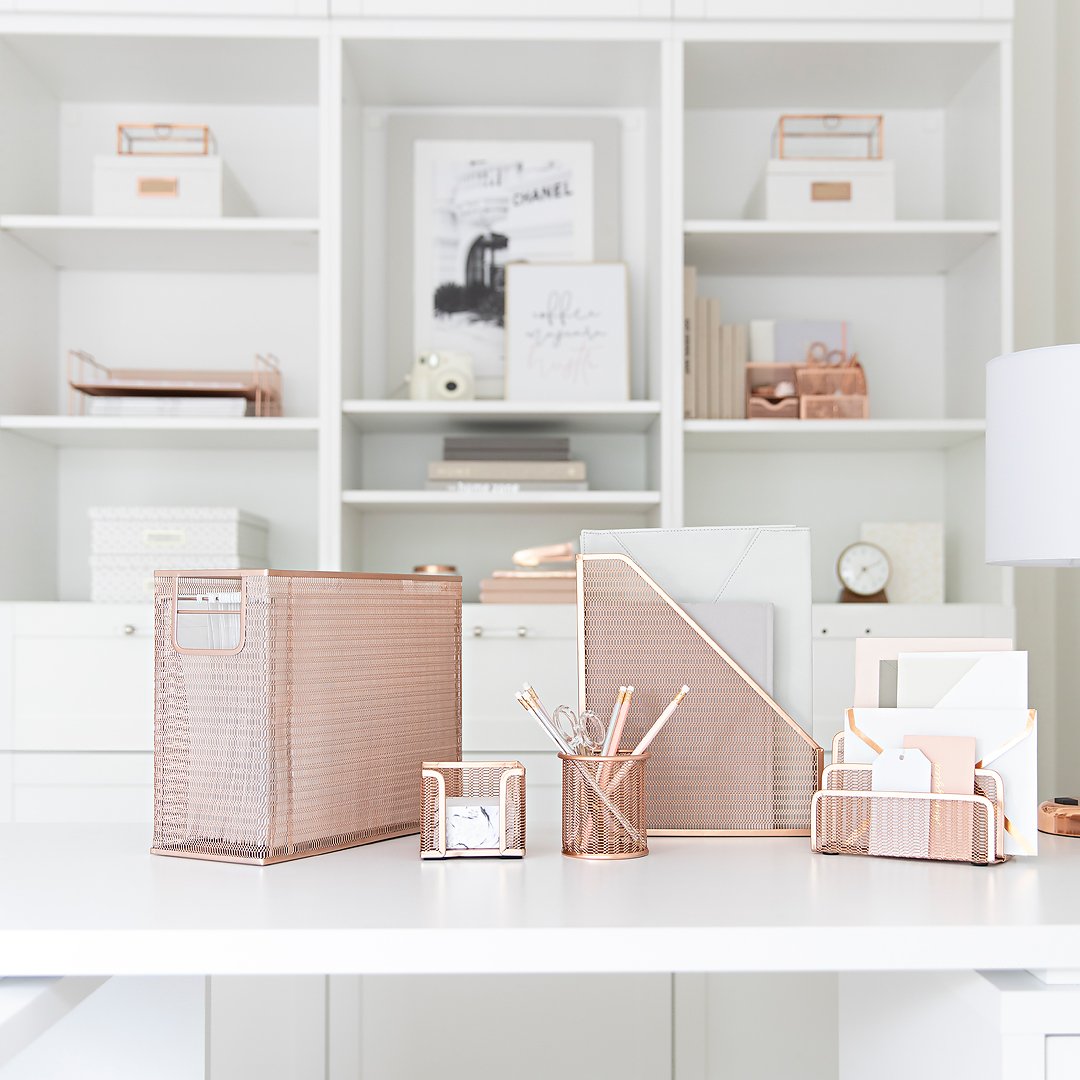
The Reference Zone: This area is within easy arm's reach but not directly in your line of sight. It’s perfect for items you need frequently but not constantly. Think of a stylish Blu Monaco paper tray for your "inbox" of documents, or a pen holder with your go-to writing tools.
The Storage Zone: This is everything else—drawers, shelves, or wall-mounted organizers. It’s for supplies, long-term files, and anything that isn't part of your immediate workflow. The goal is to keep these items accessible but out of sight to maintain a clear, focused primary workspace.
Picture a teacher using a color-coordinated set of trays in their reference zone—one for papers to grade, another for assignments to hand out, and a third for administrative forms. This simple system instantly clarifies their priorities and cuts down on the time they waste sorting through piles.
Once your zones are defined, you can start bringing in tools that truly enhance your workflow. The idea is to create a seamless path for information and tasks to follow, minimizing friction at every single step. A classic and incredibly effective system for this is the inbox/outbox method.
Using two stacked letter trays, you can create a simple but powerful flow. All incoming mail, documents, and notes go into the top "inbox" tray. As you handle each item—paying a bill, responding to a letter, digitizing a note—it moves to the bottom "outbox" tray. At the end of the day, that outbox gets cleared. Simple.
This method does more than just organize paper; it creates a crucial psychological boundary. It contains all the "unprocessed" noise of your day, allowing you to focus on one thing at a time with a clear mind, knowing everything else has a designated place.
This approach stops your desk from becoming a sprawling, visual to-do list and transforms it into an efficient processing station.
An organized desk is only half the battle. If your workspace is physically uncomfortable, your energy and focus will plummet long before the day is over. Proper ergonomics aren't a luxury; they're a fundamental requirement for sustainable productivity.
You don't need a massive overhaul. Making just a few small, intentional adjustments can dramatically reduce physical strain and mental fatigue.
Monitor Height: The top of your screen should be at or just slightly below eye level. A simple monitor stand or even a stack of books can fix this in seconds and save your neck.
Chair Position: Adjust your chair so your feet are flat on the floor and your knees are at a 90-degree angle. Make sure your lower back is supported.
Lighting: Try to position your main light source to the side, not directly behind or in front of your screen. This simple change cuts down on glare and prevents serious eye strain.
These principles are non-negotiable, whether you're in a corporate high-rise or a corner of your living room. For those starting from scratch, we’ve put together more in-depth advice in our guide detailing how to set up a home office. Trust me, a comfortable, supportive environment is your best defense against the afternoon slump, keeping you energized and focused from morning to evening.
Ever notice how a desktop littered with random files feels just as chaotic as a desk buried under piles of paper? That digital mess isn’t just an eyesore—it's a real drag on your focus. Every time your eyes scan over a disorganized desktop or a bursting inbox, your brain has to work overtime to filter out the noise. It’s a silent killer of deep, productive work.
The real breakthrough happens when you stop seeing your physical desk and your digital desktop as two separate worlds. They’re two sides of the same coin. When you get them working in harmony, creating one intuitive system, the friction just melts away. Your workflow starts to feel effortless because everything has its place, both on-screen and off.
Think of it like this: your workspace is a complete ecosystem. It’s not just about a clean desk or an empty inbox, but how everything works together.
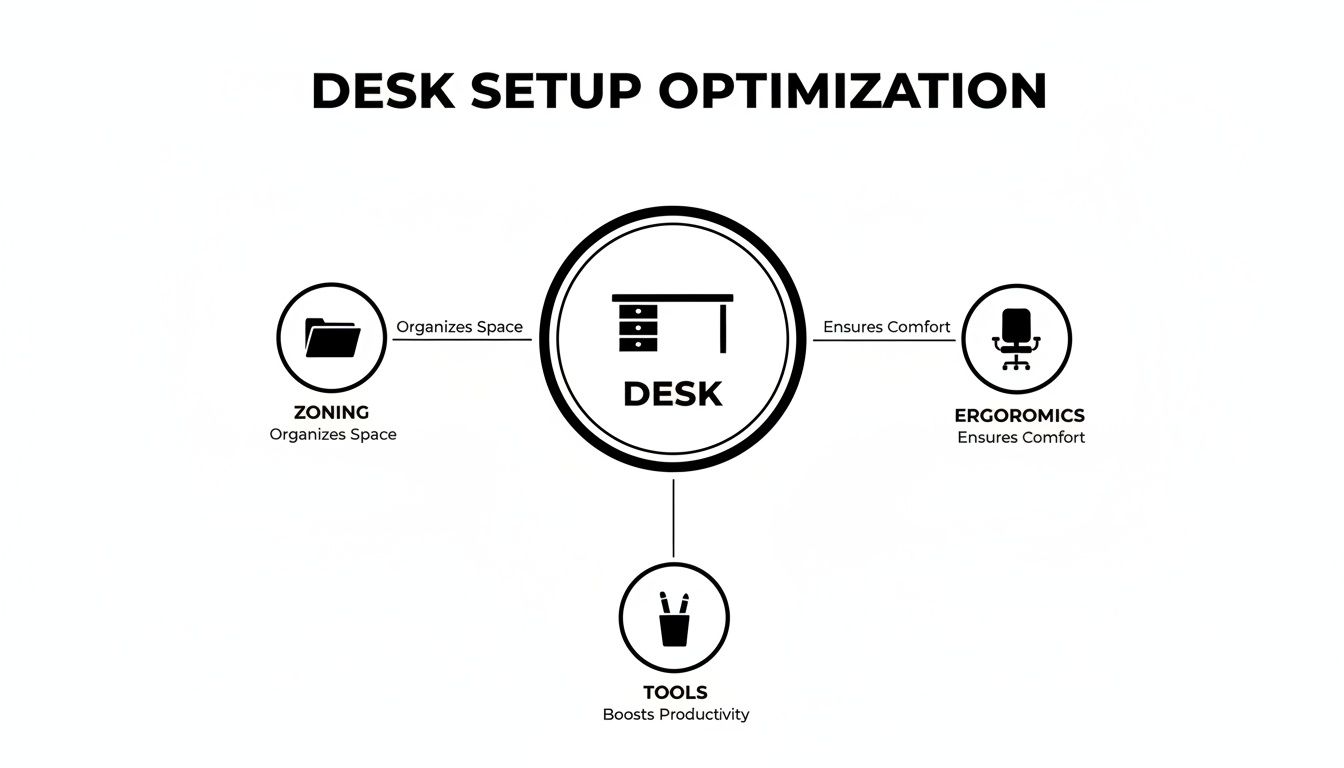
This diagram really hits home that an efficient desk is a strategic blend of how you structure your space (zoning), how you support your body (ergonomics), and the tools you choose to get the job done.
Treat your computer's desktop with the same respect you give your physical desk. It’s prime real estate for active work, not a digital dumping ground. A cluttered screen forces your brain to process irrelevant junk, and that’s a huge waste of mental energy.
Let's start by building a simple, logical folder system. It should be so intuitive that you never have to second-guess where a file belongs.
Here's a tried-and-true structure that works for almost everyone:
Current Projects: This is your action zone. Inside, create a subfolder for each project you’re actively working on. No exceptions.
Archive: As soon as a project is finished, move its entire folder here. This keeps your active workspace lean and focused.
Reference: A home for things you need often but aren't tied to one project—think brand guidelines, templates, or important contact lists.
Inbox / To Process: This is the only designated landing zone for new downloads and unsorted files. Get into the habit of clearing it out daily, just like a physical inbox tray.
Now for the magic. Let's connect that slick digital system to your physical space. This is where well-chosen organizers, like those from Blu Monaco, stop being just desk accessories and become crucial parts of your productivity engine. The goal is a seamless flow from the physical item in your hand to the digital file on your screen.
Picture this: you have a sleek, wall-mounted file holder right by your desk. This becomes your dedicated "scanning station." Every physical paper that needs to be digitized—an invoice, notes from a meeting, a client contract—goes straight into this holder. Then, once a day, you process it all. Scan the documents, save them to the right digital folder, and either file or shred the originals.
That simple routine is a game-changer. It creates a powerful, tangible link between your physical and digital worlds. The wall holder is a physical representation of your "To Process" folder, making sure nothing ever gets lost in translation.
That’s just one way to get your two worlds speaking the same language. Let's build out a complete toolkit that shows how physical and digital tools can align perfectly.
Here’s a quick guide to pairing the right physical and digital tools to create a unified system. Think of this as your blueprint for a high-efficiency workspace where every element has a purpose.
| Efficiency Goal | Blu Monaco Solution (Physical Tool) | Complementary Digital Tool |
|---|---|---|
| Manage Incoming Tasks & Paperwork | Stackable Paper Trays (Inbox/Outbox) | Trello or Asana Board |
| Organize Active Project Materials | Color-Coordinated File Folders & Holders | "Current Projects" Folder in Dropbox |
| Keep Reference Items Accessible | Desktop Magazine File Holder | "Reference" Folder in Google Drive |
| Capture Quick Ideas & Notes | Sticky Note & Pen Holder Set | Digital Note-Taking App like Notion |
When you intentionally pair your physical organizers with their digital counterparts, you’re not just getting organized—you’re building a cohesive environment that actively supports your focus.
For more brilliant ways to create this kind of harmony, you should definitely check out these home office organization ideas for a ton of inspiration. The secret is consistency. When your physical and digital worlds finally speak the same language, you’ll be amazed at how much more you can accomplish.
So, you’ve decluttered your space and organized your digital files. That's a huge win! But a tidy desk is only half the battle. The real magic happens when you master how you work throughout the day.
This is all about building smart habits that make productivity feel less like a struggle and more like second nature. When you have a solid routine, you stop wasting precious mental energy figuring out what to do next. Instead of just reacting to whatever pops up, you’ll be in the driver’s seat, steering your day with intention.
If you constantly feel like you're running out of hours, I can't recommend time blocking enough. It’s a simple concept with a massive impact: you schedule specific blocks of time on your calendar for every single thing you need to do. Your to-do list stops being a collection of wishes and becomes a concrete roadmap.
Think about a teacher juggling a million things. They could block 8:00-9:00 AM for lesson planning, carve out 1:00-2:30 PM for grading, and dedicate 3:00-3:30 PM to answering parent emails. This structure builds a fortress around their most important work, shielding it from the constant stream of interruptions.
What I love about this method is how it forces you to be honest about your time. It’s a reality check that prevents over-commitment and helps you build a schedule you can actually follow, which does wonders for your morale.
By giving every minute of your day a job, you leave no room for distraction or indecision. Time blocking transforms your calendar from a record of appointments into a strategic plan for your life.
To really make this stick, bring it into your physical space. Having your schedule right there on your desk is a powerful, visual cue. A great tool like Blu Monaco's daily planner to-do list notepad can be the perfect partner to your digital calendar, keeping your plan front and center.
For those big projects that demand serious brainpower, the Pomodoro Technique is an absolute game-changer. It’s a beautifully simple way to beat procrastination and keep your focus sharp. You just break your work into short, timed sprints.
Here's how it works:
Pick one task. Just one. No multitasking allowed.
Set a timer for 25 minutes and go all-in on that single task.
When the timer dings, take a 5-minute break. Get up, stretch, grab some water—anything but work.
Repeat! After four of these cycles (or "Pomodoros"), give yourself a longer break of 15-30 minutes.
This system is brilliant because it makes daunting tasks feel completely doable. You’re not tackling a four-hour report; you’re just committing to 25 minutes of focused work. It’s a mental trick that also trains your brain to ignore distractions, because you know a break is always right around the corner.
Imagine a software developer wrestling with a tricky piece of code. Using Pomodoros helps them stay in the zone, minimizing the urge to check Slack or email. Those short breaks are just enough to prevent burnout and keep their mind fresh. It’s a systematic way to protect your attention, which is your most valuable asset.
The real secret to making any of this work long-term? Consistency. The perfect routine is the one you can actually follow day in and day out, especially on the days you don't feel like it. Start small and create clear rituals that tell your brain it’s time to get down to business.
Your "Startup" Ritual: Kick off every morning the same way. Maybe it's five minutes of tidying your desk while your coffee brews, or reviewing your time-blocked schedule and setting your top three priorities for the day. This simple act shifts you into "work mode."
Your "Shutdown" Ritual: How you end your day is just as important. Spend the last 15 minutes clearing your workspace, checking off what you accomplished, and mapping out a rough plan for tomorrow. This creates a sense of closure and makes the next morning feel way less chaotic.
These routines aren't about being rigid—they're about creating a framework that liberates your mental energy. When your workflow is driven by habit, you free up your brain to do what it does best: solve problems, think creatively, and do meaningful work. You’ll find that productivity isn't something you have to chase anymore; it’s just the natural outcome of a well-designed day.
Getting organized isn't a one-and-done project. Think of it as a living practice, something that needs to be nurtured. The real magic happens when you build a system that can adapt and grow with you, turning that initial burst of inspiration into a lasting habit. This is how you make sure all your hard work pays off for good.
Forget getting lost in complex spreadsheets or analytics. The goal is to find simple, meaningful ways to see how you're doing. This isn’t a performance review; it’s a friendly check-in with yourself. When you can actually see the positive results of your changes, you'll naturally feel motivated to keep going.
After all, you can't improve what you don't measure. But don't let that intimidate you. Start by focusing on a few key things that genuinely impact your day and show how your efforts are making a difference.
Your personal measures of success—often called key performance indicators or KPIs—should be super straightforward. They are the vital signs of your productivity. The trick is to pick just a few that feel right for you, so tracking them doesn't become just another chore.
Here are a few ideas to get you thinking:
Daily Wins: Simply counting the number of tasks you cross off your list each day can be a huge motivator. Watching that number climb is clear proof that your new setup is working.
Deep Focus Time: How many focused work sessions did you complete? Tracking these uninterrupted blocks of time is a fantastic way to see how well you're tuning out distractions.
Time Recaptured: This one is huge. Every time your new Blu Monaco desk organizer helps you find a pen or a file in seconds instead of minutes, make a mental note. Those little moments add up fast!
And don't forget to pay attention to how you feel. Are you ending the day less stressed? More in control? Feeling accomplished is one of the most powerful signs that you’re on the right track.
Tracking your progress is about more than just numbers; it’s about building a story of your own success. Seeing tangible proof that your small changes are making a big difference creates a powerful feedback loop that fuels your motivation to keep improving.
The secret to making this all stick is a simple, repeatable habit of reflection. Carve out just 15-20 minutes at the end of each week for a quick review. This little ritual is your chance to step back and make sure your system is still working for you, not against you.
During your weekly check-in, just ask yourself three questions:
What went right? Pinpoint what felt easy and seamless. Did your inbox/outbox trays finally conquer the paper pile? Did time blocking protect your most important work? Celebrate those wins!
What felt clunky? Be honest about the friction points. Are digital files still piling up on your desktop? Is a certain task always derailing your schedule? Identify what needs a little love.
What's one small tweak I can make? Based on your answers, decide on one tiny, actionable adjustment for next week. This isn’t about a massive overhaul. It’s about making small, consistent improvements.
Maybe you decide to relabel a few folders in your new filing system or commit to clearing your digital "to-do" folder every morning. The key is to keep evolving. This way, your system never gets stale. It grows right along with you, ensuring your newfound efficiency is truly built to last.
So, here we are. You've walked through the steps—from clearing the clutter on your desk to taking back control of your calendar. What we’ve built together isn't just a collection of tips; it's a complete system designed to support your best work.
The real goal was never about achieving some sterile, picture-perfect office. It’s about creating a space that hands you back the gifts of focus and clarity. It’s about reclaiming your time and energy for the work that genuinely lights you up.
This is about making everything click. Your physical space, your digital tools, and your daily habits should all work together, not against each other. Imagine the effortless flow of grabbing a document from your Blu Monaco paper tray and instantly knowing where its digital counterpart lives. That’s the kind of seamless harmony we're aiming for.
Let's be honest, just getting more done is only half the battle. The real win is feeling more connected and energized by the work you're doing. This isn't just a nice idea; it's a critical driver of performance.
Global surveys are telling us a clear story: only 21% of employees report feeling engaged at work. Yet, that engaged minority sees 14% higher productivity and far lower absenteeism. When you take charge of your environment, you're making a direct investment in your own engagement and well-being. If you're curious, you can learn more about Gallup's 2023 workplace report and what it means for people like us.
Remember, an efficient workspace isn’t the finish line—it’s the launchpad. It’s the solid ground that frees your mind to innovate, create, and find real joy in what you do every day.
Your transformed workspace is ready and waiting for you. Don't just check these ideas off a list. Weave them into the fabric of your workday. Build your system, tweak it as you go, and watch it empower you to do more than you ever thought possible.
The future of your work isn't just about being efficient. It’s about being inspired.
Taking the leap to get your workspace truly organized is a fantastic feeling. But as you get into the nitty-gritty, it's completely normal for a few questions to surface. Let's walk through some of the most common snags people hit and how to move past them.
This is probably the number one frustration I hear. You spend a whole weekend getting everything perfect, and by Wednesday, it looks like a tornado hit. Sound familiar? The secret isn't a massive, one-time overhaul; it’s about building small, sustainable habits.
Think of it less like a deep clean and more like daily maintenance.
Try the "touch it once" rule. The next time you pick up a document or a sticky note, decide its fate right then and there. Does it need action? Does it need to be filed? Can it be tossed? Don't let it go back into a "deal with it later" pile.
Give yourself a 5-minute reset. Before you shut down for the day, take just five minutes to put things back in their home. Pens in the pen cup, papers in their designated tray, and a quick wipe of the desk. This tiny habit is a game-changer and stops little messes from snowballing.
Ah, the classic motivation dip. It’s easy to ride that initial wave of inspiration, but what about a month from now? To keep the momentum going, you have to connect your new systems to a bigger "why" and consciously celebrate your wins.
Don't forget what it felt like to be drowning in clutter and constantly stressed. Your organized space isn't just for looks; it's a tool for calm, focus, and control over your day. That feeling is what you're fighting for.
Don’t just move on after a small win—savor it. The moment you find that report in seconds instead of ten minutes? Acknowledge it. That feeling of leaving a clean desk behind on a Friday? That's your reward. This creates a positive feedback loop that makes the effort feel incredibly worthwhile.
Good news: it won't be, and it doesn't need to be! The goal isn't to create a flawless, museum-quality workspace on day one. The most effective organization system is a living one that adapts as your needs change.
If a folder system starts to feel cumbersome or a time-blocking technique isn't clicking, don't be afraid to adjust it. Your workspace should serve you, not the other way around. Give yourself permission to experiment, tweak, and refine. This is a journey of continuous improvement, not a destination of instant perfection.
Ready to build an efficient, inspiring workspace that truly works for you? Discover stylish and functional desk accessories at Blu Monaco to bring your vision to life. Shop our collections today


