No products in the cart.

Being pulled in a million directions isn't a badge of honor—it's a roadblock to doing work that actually matters. If you truly want to learn how to prioritize your work, the goal isn't just to be busy. The goal is to be truly effective, and that starts with making deliberate choices that directly support your most important goals.
This whole transformation begins by creating an environment, both mentally and physically, that champions focused, high-impact work.
Let’s be honest. In today's work culture, the constant flood of notifications, back-to-back meetings, and "urgent" requests can create a powerful illusion of productivity. It’s easy to feel like you’re getting a lot done when you’re constantly putting out fires and clearing your inbox. But are you moving the needle on what truly matters?
This is where so many of us get stuck: confusing activity with accomplishment. Shifting that mindset is the absolute first step.
Real effectiveness has nothing to do with perfecting your to-do list or finding the one "magic" app. It’s about making conscious, intentional choices about where you invest your most precious resource: your time and attention. If you're serious about this journey, it helps to start by mastering time and priorities. It's a strategic decision to zero in on the work that creates the most significant value, even when it isn't the loudest or most urgent thing demanding your focus.
Think about it: your physical environment sends powerful cues to your brain. A cluttered, disorganized desk can directly contribute to mental clutter, making it nearly impossible to think clearly and nail down what’s most important. On the flip side, an organized workspace brings a sense of calm and control, priming your mind for deep, focused effort.
"A cluttered space reflects a cluttered mind. Taking the time to organize your physical environment is the first step toward organizing your thoughts and priorities."
Picture a desk where every single tool has a home. This isn't just about looking good; it's about removing friction from your day. When your pens, planner, and important files are exactly where they need to be, you stop wasting mental energy on tiny, distracting decisions.
Using coordinated desk accessories and a simple filing system makes staying organized feel almost automatic. This physical order reinforces your mental commitment to tackling what really counts, helping you turn chaos into clarity. For more ideas on how to do this, check out our guide on how to improve workplace efficiency.
You can't organize a mess you can't see. So, the first and most liberating step in truly mastering your workload is to stop using your brain as a filing cabinet. Our minds are incredible idea-generation machines, but they are notoriously unreliable for storage. Trying to juggle every deadline, project idea, and random thought creates a constant, low-level buzz of anxiety that quietly kills your focus.
The only way out is to perform a complete "mind sweep." This is a powerful technique where you get every single to-do—big, small, and everything in between—out of your head and onto paper or a screen. This isn't about making a perfect, organized list right off the bat. It's about total capture. The goal here is to create one single source of truth for everything on your plate, which in turn frees up the mental bandwidth you need to think strategically.
Your capture system can be anything that feels right to you. A digital app like Todoist, a section in your Notion dashboard, or even a simple spiral notebook. The only rule? It has to be something you trust and can get to in a second.
Once you’ve picked your tool, block out 30 minutes. No interruptions. Just write down every single thing that has your attention.
Don't edit, don't judge, don't organize. Just dump it all out. Your list will probably be a chaotic mix of work and personal life, and that’s exactly how it should be.
Big Projects: "Launch the Q4 marketing campaign," or "Prepare my annual performance review."
Small Tasks: "Email finance about that expense report," or "Finally book that dentist appointment."
Vague Worries: "Figure out my career development path," or "The team seems a bit disengaged lately."
I know, this first list will look like a jumbled mess. But that mess is the raw material for clarity. You're moving from a state of mental clutter to having a complete inventory of every single one of your commitments.
By getting all your tasks out of your head, you reclaim precious cognitive energy. Instead of burning fuel just trying to remember what you have to do, you can finally use that energy to actually do it.
Okay, you've got your master list. Now it's time to translate those raw notes into clear, actionable steps. Vague items like "finish report" are impossible to prioritize because they aren't actually tasks; they're blurry outcomes. You have to break them down.
For example, that daunting "finish report" item might actually look like this:
Pull the Q3 sales data from the analytics dashboard.
Write a first draft of the executive summary and key findings.
Send the draft over to Sarah for her review.
Incorporate her feedback and create the final charts.
See the difference? This process turns overwhelming blobs of work into bite-sized pieces you can actually schedule and attack. If you're a visual or tactile person, physical tools can make a huge difference here. Things like the Blu Monaco file sorters let you physically sort incoming papers and documents, creating a tangible workflow that mirrors the mental clarity you're building.
Once you've captured everything on your to-do list, it’s time to decide what truly deserves your attention first. This is where a good prioritization framework comes in.
Think of these frameworks less as rigid rules and more as mental models to help you see your work with fresh eyes. You don't need to master them all. The goal is to find one that clicks with your personal style and brings a sense of calm and control to your day.
Choosing the right system is especially critical when you're trying to figure out how to manage multiple projects without feeling like you're constantly dropping the ball. Let’s look at a few powerful, time-tested methods to get you started.
One of my all-time favorites is the Eisenhower Matrix, a brilliantly simple tool named after President Dwight D. Eisenhower. It forces you to evaluate every task against two criteria: its urgency and its importance.
This is a powerful distinction. We often get caught up in tasks that feel urgent but don't actually move the needle on our most important goals.
"What is important is seldom urgent and what is urgent is seldom important." - Dwight D. Eisenhower
The matrix helps you shift from a reactive mindset—just putting out fires—to a proactive one focused on creating real, long-term value. You sort your tasks into one of four quadrants:
Do First (Urgent & Important): These are your non-negotiables. Think of a critical project deadline or a major client crisis that needs immediate attention.
Schedule (Important, Not Urgent): This is where the magic happens. It’s for strategic planning, professional development, and relationship building. You have to be intentional and block out time for these, or they’ll never get done.
Delegate (Urgent, Not Important): These tasks shout for your attention but don't require your unique expertise. Can a colleague handle that routine report? Can you automate that recurring data entry task?
Delete (Not Urgent, Not Important): These are the distractions and time-wasters. That endless scrolling through emails? That "nice-to-have" task with no real impact? Get rid of it.
This decision tree gives you a quick visual guide for sorting your tasks using this powerful logic.
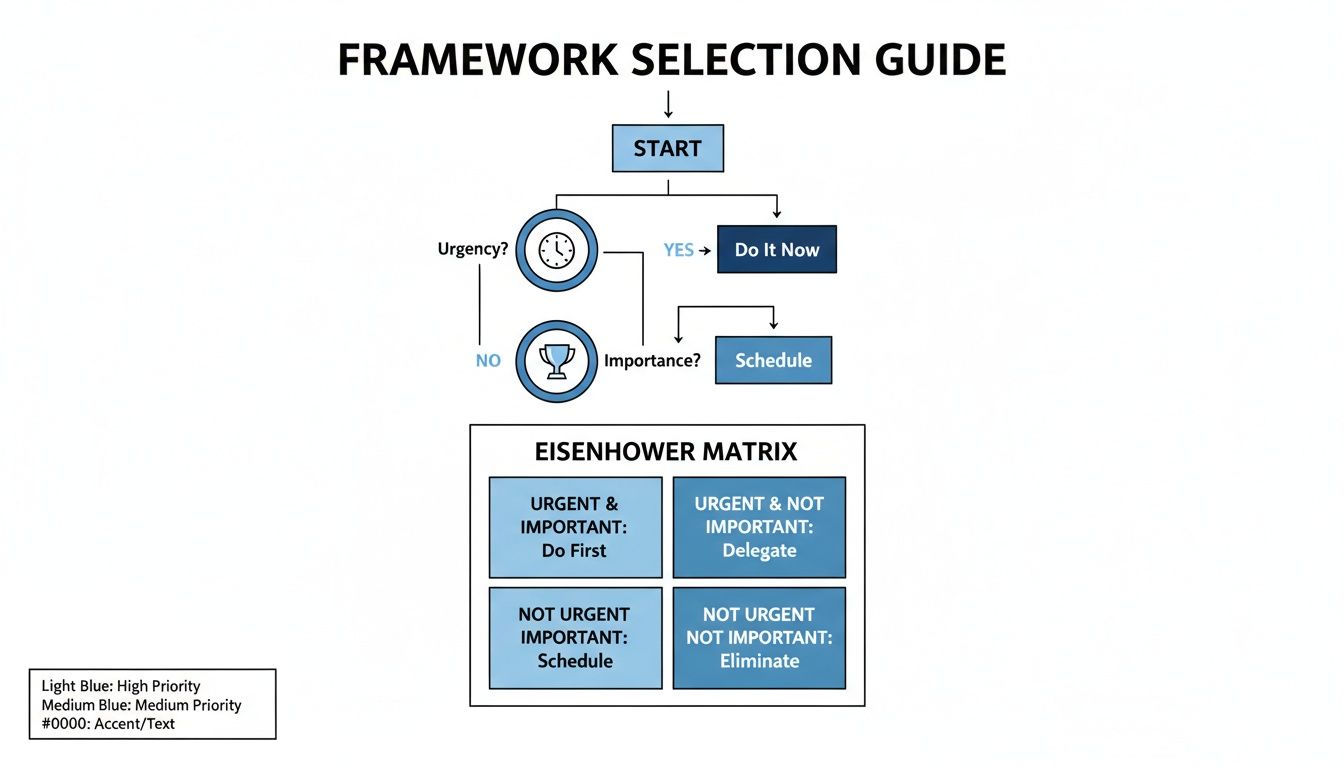
As you can see, the matrix brings instant order to chaos by asking a simple question at each step.
If the four-quadrant system feels a bit much, the ABCDE method provides a simpler, more linear way to rank your list. It’s all about consequences.
A Tasks: These are the absolute must-dos. Not doing them would have serious negative consequences.
B Tasks: Important, but the consequences of delaying them are mild. Only tackle these after your "A" tasks are complete.
C Tasks: These are the "nice to do" items. It would be great to get to them, but there are no real consequences if you don't.
D Tasks: Anything you can Delegate. Hand it off and forget about it.
E Tasks: Tasks you can completely Eliminate. Cross them off the list for good.
For those of us who get paralyzed by a massive to-do list, the Most Important Tasks (MITs) method is a lifesaver.
Forget the endless scroll. Instead, you identify just 1-3 absolute priorities for the day. These are the tasks that, if you get them done, will make the day a genuine success. This forces you to be ruthless with your focus and guarantees you’re always making meaningful progress.
Feeling a little overwhelmed by the options? Don't be. The best method is the one you'll actually use. This table breaks down which framework might be the best fit for your personality and work style.
| Framework | Best For | Key Benefit | Blu Monaco Tool Pairing |
|---|---|---|---|
| Eisenhower Matrix | Visual thinkers and strategic planners who need to separate reactive work from proactive goals. | Forces a clear distinction between what’s truly important and what’s just making noise. | A 4-tier paper tray to physically sort tasks into the four quadrants. |
| ABCDE Method | List-makers and anyone who prefers a straightforward, linear ranking system. | Simple and quick to apply, providing a clear hierarchy based on consequences. | A daily planner notepad to rank and rewrite your list each morning. |
| Most Important Tasks (MITs) | People who get easily overwhelmed or have a tendency to procrastinate on big projects. | Builds momentum and ensures progress on high-impact work every single day. | A sleek folio or sticky notes to keep your 1-3 MITs front and center. |
Ultimately, you can even mix and match. You might use the Eisenhower Matrix for your weekly planning session and then pull your daily MITs from the "Do First" and "Schedule" quadrants.
The key is to experiment and find a rhythm that transforms your to-do list from a source of stress into a roadmap for success.
A perfectly prioritized to-do list is a beautiful thing. But let's be honest—without a real plan to bring it to life, it’s just a list of good intentions. The real magic happens when you build a bridge between knowing what to do and actually doing it. This is where you turn your strategy into an action plan by scheduling your priorities and fiercely defending that time.
It all starts by moving your most important tasks off your list and directly onto your calendar. This is the heart of time blocking, a game-changing practice where you make non-negotiable appointments with your work. Instead of a vague goal like "Work on the project proposal," you schedule a specific slot: "9:00 AM - 10:30 AM: Draft Q3 project proposal outline."
That simple shift from intention to commitment makes it so much harder to get sidetracked by whatever feels urgent in the moment.
Getting your schedule sorted is only half the battle. The real challenge is protecting it from the endless stream of pings, emails, and "quick questions" that define the modern workday. Even the most carefully laid plans can get completely derailed before you’ve even had your first coffee.
A plan is only as good as your ability to protect it. Your schedule is the blueprint, but defending your focus is how you build something meaningful.
To truly get a handle on how to prioritize tasks at work, you have to become a guardian of your time. This means setting clear boundaries and letting people know about them.
Silence the Noise: Go on a notification diet. Turn off everything non-essential on your phone and computer when you're in a focus block.
Signal Your Status: Use your team's Slack or Teams status to your advantage. A simple "Focusing" or "Do Not Disturb" works wonders.
Batch Your Communication: Stop reacting to every email and message as it lands. Instead, set aside specific times in your day—maybe once in the late morning and once in the afternoon—to tackle them all at once.
Defending your schedule isn't just a "nice to have"—it's a strategic necessity. We're facing a genuine interruption crisis at work. Studies show workers are interrupted roughly every three minutes, and it can take over 23 minutes to get back into a state of deep concentration after each one. That fragmentation makes sustained, high-quality work almost impossible. In fact, some research shows office staff are truly productive for only 31% of their day. You can discover more insights about workplace productivity to see just how deep this challenge runs.
Learning to say "no" (or maybe "not right now") is one of the most valuable skills you can develop. It’s not about being unhelpful; it's about honoring the commitments you’ve already made.
Try a few of these phrases:
"I'm deep in a priority task right now, but I can take a look at this after 2 PM. Does that work for you?"
"That sounds important. Let’s find a time on the calendar to give it the focus it deserves."
Don't forget your physical environment is a powerful ally. An organized desk, anchored by stylish and functional Blu Monaco accessories, sends a visual signal to your brain that it’s time to get down to business. It cuts down on physical distractions and reinforces your mental commitment. Tools like a well-designed minimalist daily planner with an hourly schedule can also make scheduling and time blocking a tangible, even satisfying, ritual.
We live in a world that sells us the myth of multitasking, but the most productive people I know are quietly doing the exact opposite. They’ve tapped into a powerful secret: real progress comes from monotasking—the art of pouring your full, undivided attention into one single thing at a time. This isn’t about working slower; it’s about moving forward faster and with far greater precision.
I get it. The temptation to juggle a dozen things at once is real. But the science behind it is crystal clear. Every time you jump from writing a report to checking an email, then over to a Slack notification, your brain pays a price. This "context switching" is mentally exhausting, slowing you down and tanking the quality of your work.
Honestly, multitasking is one of the most destructive habits you can have when you're trying to figure out how to prioritize tasks at work. Research quantifies its devastating impact, revealing it can slash productivity by a staggering 40%. It’s a massive performance killer.
This pressure to juggle is also a huge source of stress. Is it any wonder that productivity anxiety affects 80% of employees? If you're curious, you can dig into more data on the costs of multitasking and productivity anxiety to see the full picture.
Think of single-tasking as a muscle. You have to train it. The shift from a scattered, multitasking mindset to a focused one starts with creating an environment—both physical and digital—that actively protects your attention.
The fastest path to meaningful progress isn't doing more things at once. It's doing one important thing with your complete, unwavering focus.
A fantastic way to start building this muscle is with the Pomodoro Technique. It's simple: work in short, intense sprints (usually 25 minutes), followed by a quick 5-minute break. During that 25-minute block, you commit to one task and one task only. No email. No phone. Just pure, uninterrupted focus.
This practice rewires your brain to resist the siren call of distractions and builds your capacity for sustained concentration. It's a game-changer for making real, tangible progress on your most important work every single day.
To really make this stick, your physical workspace needs to be your greatest ally. A clean, organized desk sends a powerful signal to your brain: it's time to focus. Having the right work-from-home desk essentials from Blu Monaco can help you create this sanctuary, turning your desk into a partner in your quest for clarity.
When you dedicate specific, protected blocks of time to your top priorities, you're not just organizing your calendar. You're fundamentally transforming the way you work for the better.
Learning to prioritize your work isn’t a one-and-done project. Think of it less like building a rigid structure and more like tending a garden; it's a living system that needs to breathe and evolve right alongside your goals and responsibilities. The true mark of mastery isn't a perfect, unchanging plan, but a resilient process you consistently fine-tune.
This is where the real magic happens: the regular review. Your prioritization framework, whether it's an Eisenhower Matrix or an ABCDE list, is a tool, not a cage. If it starts to feel more like a burden than a relief, that’s your cue to adapt, not to abandon the effort entirely. The whole point is to build a flexible system that actually serves you.
A simple, consistent review habit is what separates the people who sustain their productivity from those who eventually burn out. It's your built-in opportunity to learn from your own workflow, celebrate what went right, and spot bottlenecks before they grow into full-blown crises.
This doesn't have to be some complicated, hours-long affair. In fact, it's better if it's not. Start with small, manageable check-ins that you can stick with:
The 5-Minute Daily Wind-Down: At the end of each workday, just glance at what you accomplished. Did your priorities for the day hold up? What unexpected curveballs threw you off? This quick reflection is a powerful way to build self-awareness.
The Weekly Reset (15-30 Minutes): Use Friday afternoon to look ahead. Do the priorities on your plate for next week still align with your larger goals? This is your chance to adjust the game plan, ensuring your actions stay intentional.
A prioritization system that isn't reviewed is already obsolete. True control comes not from a perfect plan, but from the habit of adapting that plan to reality.
This consistent review process does more than just keep you organized; it fuels your motivation. When your daily actions feel connected to meaningful goals, your engagement skyrockets. Sadly, that connection is often missing in the workplace. Global employee engagement has hit a concerning low, with only 21% of employees feeling engaged at work.
This disconnect directly sabotages our ability to prioritize, as people who aren't engaged struggle to see the difference between just being busy and doing high-impact work. Interestingly, 77% of employees report being more productive at home, which suggests that having autonomy over how to structure and prioritize work is a powerful driver of both engagement and output. You can explore more workplace statistics to see just how deep the link between autonomy and productivity runs.
Ultimately, turning your review into a simple ritual is the key. Using a physical planner from a brand like Blu Monaco can make this process feel tangible and deeply satisfying. It’s not just about checking boxes; it’s about taking a quiet moment to ensure the work you’re doing is the work that truly matters. That’s how you stay firmly in control of your own success.
Even with the best systems in place, some days just feel like chaos. That’s normal. Learning to prioritize is less about finding a perfect, rigid method and more about building the mental muscle to navigate the mess. Let's tackle a couple of the most common curveballs you'll face.
We’ve all been there. Your to-do list is a mile long, and every single item feels like a screaming red alert. It’s a classic recipe for overwhelm, and it paralyzes you.
When this happens, your first instinct might be to work faster, but the real solution is to pause and force clarity. Take a deep breath and ask yourself one simple question: "If I could only get one thing done today to feel like I won the day, what would it be?"
That single question cuts through the noise. It helps you pinpoint what truly matters right now, not what’s just shouting the loudest.
Often, this feeling of "everything is urgent" comes from looking at huge projects instead of small, actionable tasks. "Launch marketing campaign" feels massive and urgent. But when you break it down, you realize the only truly urgent part today is "email the designer for the final ad creative." The rest can wait.
The feeling that everything is a top priority is your cue to slow down and get specific, not to speed up and multitask. Real progress is born from a single, deliberate choice.
Nothing can torpedo a perfectly planned day faster than a last-minute, high-priority request from your boss or a key client. The impulse is to drop everything and just react. Don't. The key is to assess before you act.
First, get the details. What’s the real deadline? What does a successful outcome look like? A little clarity upfront can save you hours of rework.
Then, instead of just saying "yes," you need to present a conscious trade-off. Look at what you already have planned and ask: "What am I willing to postpone to make room for this?"
This isn't about being difficult; it's about making the new reality visible. You could approach your boss and say, "I can absolutely get this done for you by the end of the day. To make that happen, I’ll need to push back the quarterly report analysis until tomorrow morning. Does that work for you?"
This simple script changes the entire dynamic. It shows you’re organized and in control, turning a disruptive command into a collaborative decision. You’re no longer a victim of your schedule—you’re the one steering the ship.
Ready to create a workspace that inspires this kind of focus and clarity? The stylish, coordinated desk accessories from Blu Monaco are designed to help you transform your environment, making prioritization feel effortless. Explore the collections and build your fortress of focus today.


